
A realistic, step‑by‑step walkthrough of what actually happens inside Korean hospitals.
Korean hospitals are fast, structured, and surprisingly efficient. But if you’re new to the system, the speed and unfamiliar procedures can feel overwhelming. This guide doesn’t just explain the system—it walks you through the exact experience you’ll have from the moment you step inside the building to the moment you leave with your prescription.
Think of this as your “first hospital visit simulation” in Korea.
1. Before You Go: Choosing the Right Type of Hospital
Korea has several types of medical facilities, each serving a different purpose.
Choosing the right one saves time and money.
Local Clinics (의원 / 내과 / 가정의학과)
For everyday issues: colds, fever, stomach pain, headaches, allergies.
Fast, cheap, and usually no wait.
Specialty Clinics (피부과, 정형외과, 이비인후과 등)
For skin, bones, ENT, gynecology, etc.
Focused treatment, modern equipment.
General Hospitals (종합병원)
For more complex issues or when you need tests like CT, MRI, ultrasound.
University Hospitals (대학병원)
Top-tier care, advanced tests, English support.
Longer wait times, higher cost.
Foreigners often start with local clinics unless symptoms are serious.
2. Arriving at the Hospital: The First 3 Minutes
Korean hospitals move fast.
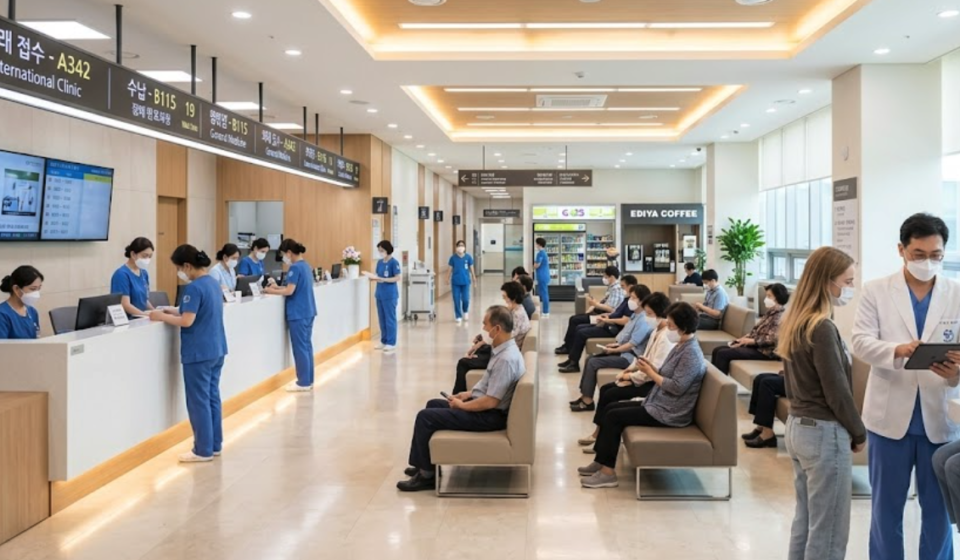
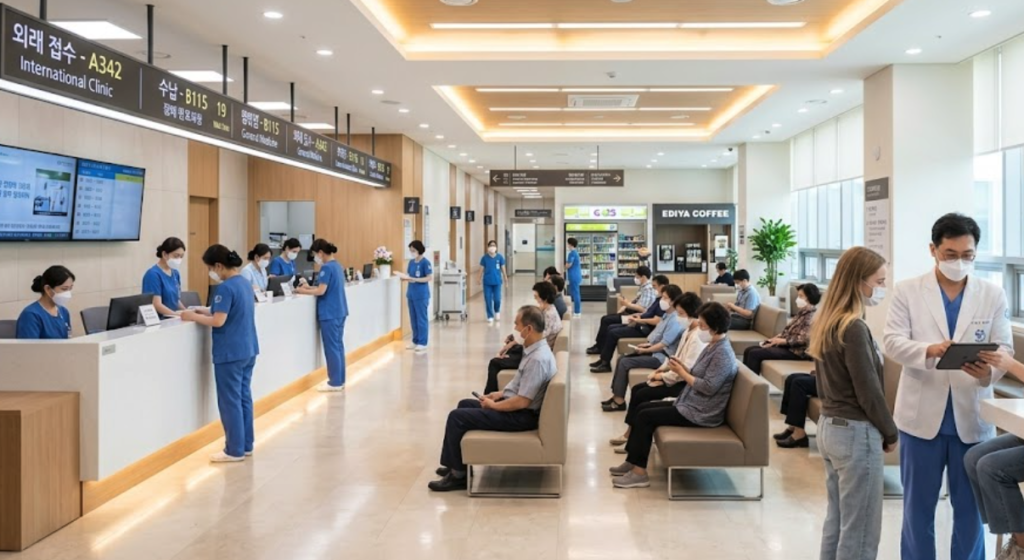
Here’s what happens the moment you walk in.
Step 1: Reception Desk (접수)
You say your name and hand over your ARC.
If it’s your first visit, they create your profile in the system.
Step 2: Short Symptom Check
A nurse may ask:
- “Where does it hurt?”
- “How long have you felt this?”
- “Do you have insurance?”
It’s brief—Korean hospitals don’t waste time.
2. Arriving at the Hospital: The First 3 Minutes
Korean hospitals move fast.
Here’s what happens the moment you walk in.
Step 1: Reception Desk (접수)
You say your name and hand over your ARC.
If it’s your first visit, they create your profile in the system.
Step 2: Short Symptom Check
A nurse may ask:
- “Where does it hurt?”
- “How long have you felt this?”
- “Do you have insurance?”
It’s brief—Korean hospitals don’t waste time.
Step 3: You Sit Down… but Not for Long
Most clinics call you within 3–10 minutes.
3. The Consultation Room: What the Doctor Actually Does
Korean doctors are direct and efficient.
The consultation usually feels like this:
1. Quick conversation
They ask simple questions:
- “When did it start?”
- “Does it hurt here?”
- “Any allergies?”
2. Immediate examination
Doctors often check your throat, abdomen, or breathing right away.
3. Decision time
Within minutes, they decide whether you need:
- Medication
- Blood test
- X-ray
- Ultrasound
- Specialist referral
Korean doctors rarely drag out the process.
You get answers fast.
4. Testing Area: The Part That Surprises Most Foreigners
If the doctor orders tests, you’re guided to another room.
This part feels different from Western hospitals.
Blood tests
Done in under 2 minutes.
Results come back in 20–30 minutes.
X-ray
You walk in, stand still, click, done.
Results appear on the doctor’s screen almost instantly.
Ultrasound / CT
Usually same-day.
University hospitals may require scheduling.
Korean hospitals are built for speed—tests happen immediately, not days later.
5. Returning to the Doctor: The “Second Consultation”
After tests, you go back to the doctor.
This is where you get:
- Diagnosis
- Explanation
- Treatment plan
- Prescription
Doctors often show your X-ray or test results on a large monitor.
It feels very transparent and reassuring.
6. Payment Counter: Understanding the Bill
This part is extremely fast.
With National Health Insurance
You pay 20–50% of the total cost.
Typical costs:
- Clinic visit: 5,000–10,000 KRW
- Tests: 10,000–50,000 KRW
- X-ray: 5,000–15,000 KRW
- Ultrasound: 30,000–70,000 KRW
Without insurance
Costs increase significantly:
- Clinic visit: 30,000–50,000 KRW
- Tests: 30,000–100,000 KRW
- X-ray: 20,000–40,000 KRW
Payment takes 10 seconds—tap your card, done.
7. Prescription Slip: The Small Paper That Matters
You receive a printed prescription (처방전).
It includes:
- Medication name
- Dosage
- Duration
- Pharmacy instructions
Korean prescriptions are extremely organized.
Foreigners often say it’s easier to understand than in their home country.
8. Pharmacy Visit: The Final Step
You walk to a pharmacy near the hospital—usually 3–5 are clustered nearby.
What happens:
- Hand over your prescription
- Pharmacist prepares your medication
- They explain dosage clearly
- You pay (usually 3,000–10,000 KRW with insurance)
Medication is often packed in small labeled packets divided by time of day.
This is uniquely Korean and very convenient.
9. English-Friendly Hospitals: Where Foreigners Feel Comfortable
Many large hospitals have international centers.
Popular options:
- Seoul National University Hospital
- Asan Medical Center
- Severance Hospital
- Samsung Medical Center
- St. Mary’s Hospital
They offer English support, translators, and foreigner-friendly services.
10. Useful Korean Phrases for Hospital Visits
- “아파요.” — It hurts
- “열 있어요.” — I have a fever
- “배 아파요.” — My stomach hurts
- “두통 있어요.” — I have a headache
- “알러지 있어요.” — I have allergies
- “보험 있어요.” — I have insurance
These simple phrases make the visit smoother.