Skip to content
-
Subscribe to our newsletter & never miss our best posts. Subscribe Now!
  • https://www.facebook.com/
  • https://twitter.com/
  • https://t.me/
  • https://www.instagram.com/
  • https://youtube.com/
KOREA MEDI HUB. COM
KOREA MEDI HUB. COM
  • K-Information
    • Korea Plastic Surgery Consultation
    • South Korea Women’s Healthcare Market
    • South Korea Dental Sleep Medicine Market
    • Liposuction in Korea

About This Site

Korea Medi Hub shares clear, practical information on Korean healthcare, beauty, and wellness for international patients considering treatment in Korea.

Recent Posts

  • Why Are Foreigners Traveling to South Korea for Rejuran? The K-Beauty Skin Treatment Attracting Global Attention
  • SMILE vs. LASIK vs. LASEK: How to Choose the Best Vision Correction Surgery
  • Where to Buy Used Medical Equipment in Korea: 10 Sites, Rules and a Buyer’s Checklist (2026)
  • Where to Stay Near Gangnam Clinics: 10 Recovery-Friendly Places for Medical Travelers
  • Neck Lift and Facelift: How a Submental Incision Improves Neck Contour and Jawline Definition
  • K-Information
    • Korea Plastic Surgery Consultation
    • South Korea Women’s Healthcare Market
    • South Korea Dental Sleep Medicine Market
    • Liposuction in Korea
Subscribe
Close

Search

Cardiac Emergencies in Korea: 119, AEDs, and What “Heart Saver” Really Means for Foreign Patients
K-Information

Cardiac Emergencies in Korea: 119, AEDs, and What “Heart Saver” Really Means for Foreign Patients

By Melissa H
August 5, 2026 3 Min Read
0

Many foreign visitors read about Korea’s “Heart Saver” and assume it is a hospital emergency system. It is not. In Korea, Heart Saver (하트세이버) is a recognition given by the National Fire Agency to people who bring a cardiac arrest patient back through CPR or an AED. This guide explains what the term actually means, how Korea responds to cardiac emergencies, and what foreign patients can check before a procedure.
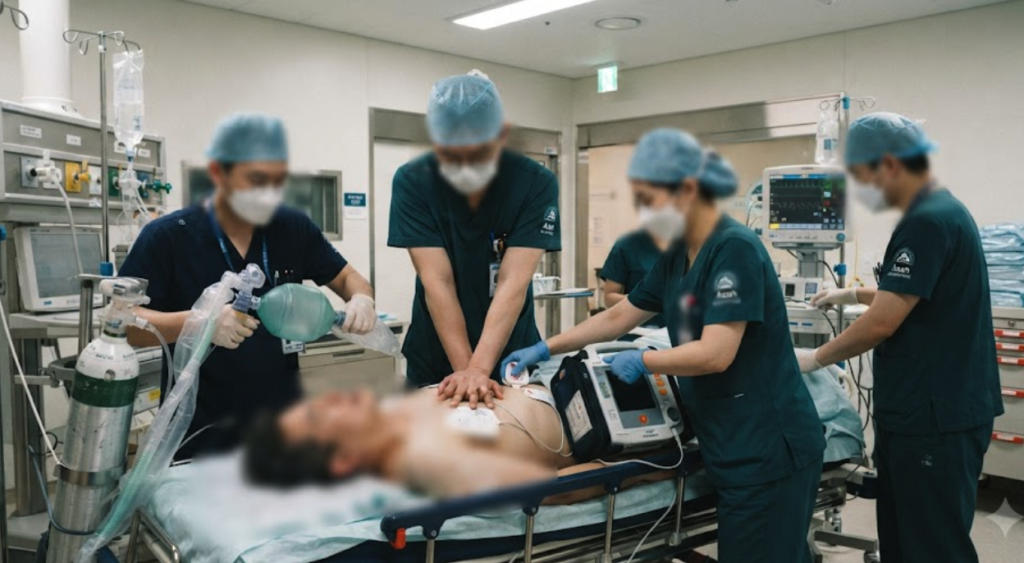
Medical team performing CPR with a defibrillator

1. What “Heart Saver” Actually Is

Since 2008, Korea’s fire services have awarded a Heart Saver certificate and badge to paramedics and ordinary citizens who restore a cardiac arrest patient’s heartbeat before the patient reaches the hospital.

Media reports describe the usual criteria as follows:

  • The heart rhythm returns before hospital arrival
  • The patient regains consciousness
  • The patient survives at least 72 hours after admission

It honors life-saving actions by people. It is not a type of equipment or a clinic protocol.

2. Calling 119

119 is Korea’s number for fire, rescue, and ambulance services. Emergency ambulance transport by 119 is free.

Several regional fire headquarters run three-way interpretation, connecting the caller, an interpreter, and the 119 dispatch center. If you are not confident in Korean, say “emergency” and your language clearly, and stay on the line. The 1330 Korea Travel Hotline (Korea Tourism Organization) can also help with interpretation.

3. AEDs in Public Places

Under Article 47-2 of Korea’s Emergency Medical Service Act, certain facilities must keep emergency equipment such as automated external defibrillators (AEDs). Examples include:

  • Medical institutions
  • Ambulances, aircraft, trains, and ships
  • Passenger terminals
  • Large stadiums
  • Government offices
  • Apartment complexes with 500 or more households
  • Workplaces with 300 or more employees

Facilities that do not comply can be fined. AEDs are usually marked with a green-and-white sign, and many give voice instructions, including in English.

4. Safety Rules Inside Korean Operating Rooms

Since September 25, 2023, Article 38-2 of the Medical Service Act has required hospitals that perform surgery on unconscious patients to install CCTV in the operating room. This covers general anesthesia and planned sedation. Filming must take place if the patient or guardian requests it, and recordings must be kept for at least 30 days.

Korean law does not require a dedicated anesthesiologist for every sedation. The Korean Society of Anesthesiologists recommends that sedation be given and monitored by an anesthesia provider who can watch the patient’s condition. Practices vary from clinic to clinic, so it is worth asking.

5. Questions Foreign Patients Can Ask Before Surgery

  • Who will give my anesthesia or sedation? Is a board-certified anesthesiologist present for the whole procedure?
  • What monitoring will be used (pulse oximetry, ECG, blood pressure, capnography)?
  • Is there an AED, oxygen, and emergency medication in the procedure area?
  • Which hospital will I be transferred to if something goes wrong, and how?
  • Can the operation be recorded on the operating-room CCTV if I request it?

A clinic that answers these questions clearly and in writing is easier to trust than one that only promises “no risk.”

6. Bottom Line

Korea has a well-developed 119 emergency network and legal rules on AEDs and operating-room CCTV. But “Heart Saver” is an award for people who save lives, not a hospital safety system, and anesthesia staffing still differs by clinic. Ask before you book.

This article is general information, not medical or legal advice. Rules can change, so check official sources (National Fire Agency, Ministry of Health and Welfare, Korea Law Information Center) for the latest details.


Share this article

Tags:

is surgery safe in koreakorea anesthesia monitoringkorea cardiac monitoringkorea heart saver systemkorea plastic surgery safetykorean clinic emergency protocolkorean emergency response
Author

Melissa H

Writer on the Korea Medi Hub editorial team. Covers Korean hospitals, clinics, and medical travel using official sources and publicly available information. Articles are for general information only and are not medical advice.

Follow Me
Other Articles
Why Korea’s Emergency Response System Is One of the Strongest in the World
Previous

Why Korea’s Emergency Response System Is One of the Strongest in the World

Temple Hollowing After Zygoma Reduction: The Hidden Side Effect Surgeons Rarely Discuss
Next

Temple Hollowing After Zygoma Reduction: The Hidden Side Effect Surgeons Rarely Discuss

No Comment! Be the first one.

Leave a Reply Cancel reply

Your email address will not be published. Required fields are marked *

About This Site

Korea Medi Hub shares clear, practical information on Korean healthcare, beauty, and wellness for international patients considering treatment in Korea.

Search

Recent Posts

  • Why Are Foreigners Traveling to South Korea for Rejuran? The K-Beauty Skin Treatment Attracting Global Attention
  • SMILE vs. LASIK vs. LASEK: How to Choose the Best Vision Correction Surgery
  • Where to Buy Used Medical Equipment in Korea: 10 Sites, Rules and a Buyer’s Checklist (2026)
  • Where to Stay Near Gangnam Clinics: 10 Recovery-Friendly Places for Medical Travelers
  • Neck Lift and Facelift: How a Submental Incision Improves Neck Contour and Jawline Definition

About This Site

Korea Medi Hub shares clear, practical information on Korean healthcare, beauty, and wellness for international patients considering treatment in Korea.

Recent Posts

  • Why Are Foreigners Traveling to South Korea for Rejuran? The K-Beauty Skin Treatment Attracting Global Attention
  • SMILE vs. LASIK vs. LASEK: How to Choose the Best Vision Correction Surgery
  • Where to Buy Used Medical Equipment in Korea: 10 Sites, Rules and a Buyer’s Checklist (2026)
  • Where to Stay Near Gangnam Clinics: 10 Recovery-Friendly Places for Medical Travelers
  • Neck Lift and Facelift: How a Submental Incision Improves Neck Contour and Jawline Definition

Archives

  • November 2026 (2)
  • October 2026 (19)
  • August 2026 (43)
  • July 2026 (20)

Categories

  • K-Information (75)
  • Korea Plastic Surgery Consultation (6)
  • South Korea Dental Sleep Medicine Market (1)
  • South Korea Women’s Healthcare Market (3)
Copyright 2026 — KOREA MEDI HUB. COM. All rights reserved. · About Us · Contact · Privacy Policy · Medical Disclaimer
English
Japanese