
Why cheekbone and jaw reduction surgeries can accelerate midface sagging — and how Korean surgeons prevent it.
In Korea’s globally recognized facial contouring industry, bone contouring surgeries such as zygomatic reduction, V‑line surgery, and mandibular angle reduction have become essential procedures for achieving a slimmer, more refined facial shape. These surgeries reshape the skeletal foundation of the face, creating dramatic improvements in width, projection, and overall harmony.
But beneath the surface of these transformations lies a lesser‑known phenomenon that only top surgeons discuss: malar fat pad descent — the downward migration of the midface fat pad that can occur after bone contouring. This descent is one of the primary reasons some patients experience sagging, hollowing, or premature aging after cheekbone or jaw reduction.
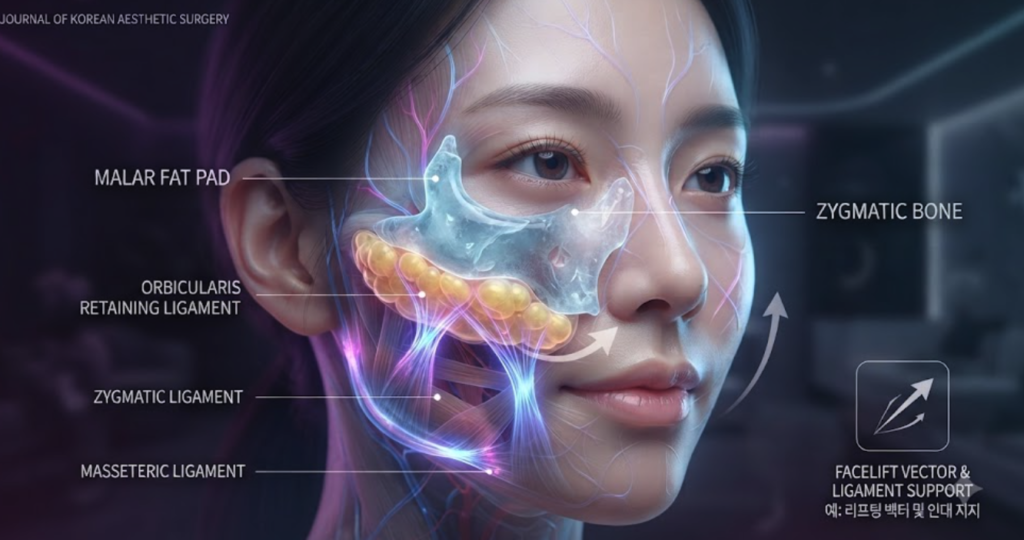
This feature explores the anatomical truth behind malar fat pad descent, why bone contouring can trigger it, who is most at risk, and how Korean surgeons prevent or correct this issue using advanced techniques such as SMAS lifting, deep plane facelift, and midface volume restoration.
⭐ What Is the Malar Fat Pad?
The malar fat pad is a triangular, thick fat compartment located on the upper cheek. It plays a crucial role in:
- Midface volume
- Youthful cheek projection
- Smooth transition from lower eyelid to cheek
- Support for the nasolabial fold
- Facial expression and contour
When the malar fat pad is well positioned, the face looks youthful, lifted, and vibrant.
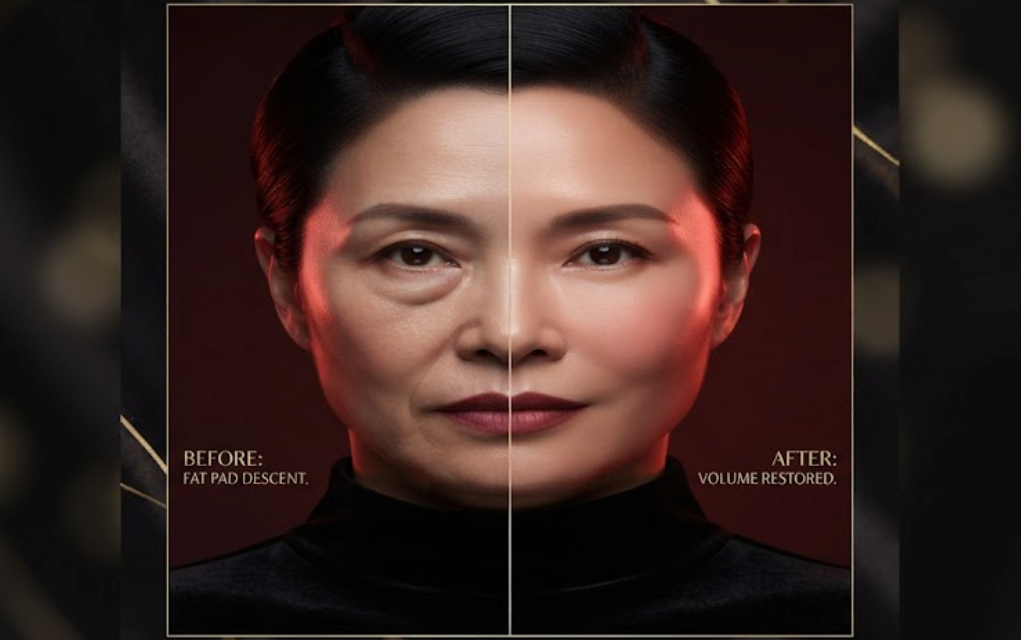
When it descends, the face can appear:
- Saggy
- Tired
- Hollow
- Heavier in the lower face
- Deeper in the nasolabial fold
This descent is a natural part of aging — but bone contouring can accelerate it.
⭐ Why Bone Contouring Can Trigger Malar Fat Pad Descent
Bone contouring changes the structural foundation beneath the malar fat pad. When the bone moves, the soft tissue above it must adapt. This adaptation can sometimes lead to downward migration.
Here are the five major reasons malar fat pad descent occurs after bone contouring:
⭐ 1) Loss of Skeletal Support After Zygoma Reduction
The cheekbone provides lateral and anterior support for the malar fat pad.
When the zygoma is moved inward:
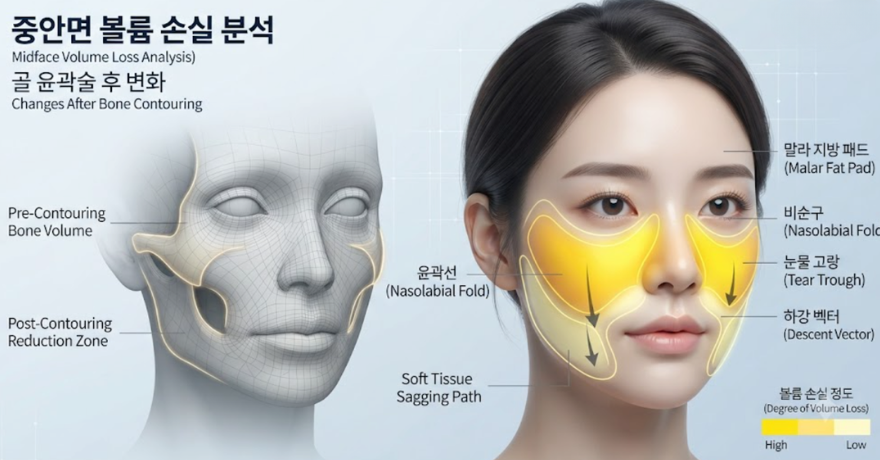
- The cheek projection decreases
- The malar fat pad loses its “platform”
- Soft tissue begins to slide downward
- The nasolabial fold deepens
This is the most common cause of midface sagging after cheekbone reduction.
⭐ 2) Soft Tissue Redundancy After Bone Narrowing
Bone contouring reduces facial width.
But the skin and SMAS do not automatically shrink to match the new bone size.
This mismatch creates:
- Extra soft tissue
- Looseness
- Downward migration
- Early jowling
This is similar to what happens after weight loss — the skin needs time and support to adjust.
⭐ 3) Changes in SMAS Tension
The SMAS (Superficial Musculoaponeurotic System) is the key lifting layer in the face.
Bone contouring can alter:
- SMAS tension
- SMAS anchoring points
- SMAS direction
When SMAS tension decreases, the malar fat pad loses its suspension and begins to descend.
⭐ 4) Midface Volume Loss After Bone Reduction
Bone reduction reduces:
- Projection
- Volume
- Structural height
This can make the midface appear deflated, causing the malar fat pad to collapse downward.
Patients with naturally thin faces are especially vulnerable.
⭐ 5) Pre‑existing Malar Instability Becomes More Visible
Many patients already have mild malar descent before surgery.
Bone contouring can reveal or worsen this by:
- Reducing cheek support
- Highlighting volume loss
- Increasing shadowing
This is why some patients feel they “aged” after cheekbone reduction — even though the surgery itself was successful.
⭐ Who Is Most at Risk?
Malar fat pad descent is more common in:
- Patients over 35
- Patients with thin skin
- Patients with low body fat
- Patients with strong nasolabial folds
- Patients with pre‑existing midface sagging
- Patients who undergo aggressive bone reduction
- Patients with weak SMAS support
Korean surgeons evaluate these factors before recommending bone contouring.
⭐ Signs of Malar Fat Pad Descent After Bone Contouring
Patients may notice:
- Deeper nasolabial folds
- Heavier lower cheeks
- Loss of cheek projection
- Early jowling
- Hollowing under the eyes
- A tired or aged appearance
These signs can appear gradually over months.
⭐ How Korean Surgeons Fix Malar Fat Pad Descent
Korea leads the world in midface rejuvenation techniques.
Surgeons use several methods to restore the malar fat pad to its proper position.
⭐ 1) SMAS Facelift (High SMAS Technique)
The most common and effective correction.
Benefits:
- Repositions the malar fat pad
- Tightens SMAS
- Improves nasolabial folds
- Restores cheek projection
- Enhances jawline definition
Korean surgeons often use High SMAS for better midface lifting.
⭐ 2) Deep Plane Facelift
The gold standard for severe malar descent.
This technique:
- Releases deep ligaments
- Elevates the malar fat pad directly
- Restores natural cheek volume
- Provides long‑lasting results
It is especially effective for patients who had aggressive bone contouring.
⭐ 3) Midface Lift (Subperiosteal Lift)
This lift targets the malar fat pad at its deepest anatomical level.
Benefits:
- Strong vertical lift
- Natural cheek contour
- Improved under‑eye hollowing
Often combined with fat grafting.
⭐ 4) Fat Grafting to the Midface
Fat grafting restores:
- Volume
- Softness
- Youthful contour
It is ideal for patients with volume loss after bone reduction.
⭐ 5) Filler Support (Temporary Option)
Hyaluronic acid fillers can temporarily:
- Lift the malar fat pad
- Improve cheek contour
- Reduce nasolabial folds
But they do not fix the underlying descent.
⭐ Can Malar Fat Pad Descent Be Prevented?
Yes — Korean surgeons prevent descent by:
- Avoiding excessive bone reduction
- Maintaining cheek projection
- Combining bone contouring with SMAS support
- Using 3D facial analysis
- Performing preventive fat grafting
- Recommending early lifting procedures
Prevention is especially important for patients over 35.
⭐ Why Some Patients Look Older After Bone Contouring
It is not the bone contouring itself that causes aging —
it is the soft tissue response.
When the malar fat pad descends:
- Cheeks lose volume
- Nasolabial folds deepen
- Lower face becomes heavier
- Midface loses height
- Shadows increase
- The face looks older
Understanding this helps patients make informed decisions.
⭐ Conclusion: Bone Contouring Must Consider Soft Tissue Behavior
Bone contouring reshapes the skeletal foundation.
But the malar fat pad determines how youthful the face appears.
Their relationship is:
- Anatomical
- Structural
- Volumetric
- Dynamic
Korean surgeons excel at balancing bone reduction with soft‑tissue support, ensuring that patients achieve a slimmer face without sacrificing midface youthfulness.
For anyone considering cheekbone or jaw reduction, understanding malar fat pad descent is essential for long‑term satisfaction and natural results.
✔ More Korean Plastic Surgery Knowledge (Global Community)
https://en.kbeautycommunity.com