
Is your neck feeling stiff or heavy? Do you experience shoulder pain, tingling in your arms or legs, or weakness when walking? These symptoms are often mistaken for a herniated cervical disc, but they may indicate a more serious condition called cervical myelopathy.
Cervical myelopathy occurs when the spinal cord in the neck becomes compressed or damaged. Unlike a condition that affects only the nerve roots, spinal cord compression can interfere with movement, coordination, balance, and sensation throughout the body. If left untreated, it may lead to permanent neurological damage or even paralysis.
What Is the Difference Between Cervical Disc Herniation and Cervical Myelopathy?
A cervical disc herniation occurs when a disc between the vertebrae in the neck bulges or protrudes, potentially pressing on nearby nerves. Common symptoms include neck pain, shoulder discomfort, and tingling or numbness that travels down the arm.
Cervical myelopathy develops when the spinal cord itself is compressed. Symptoms may initially resemble those of a herniated disc, making the two conditions difficult to distinguish based on pain alone.
The key difference is that cervical myelopathy can affect the nerves responsible for movement and coordination in both the arms and legs. As the condition progresses, people may experience muscle weakness, difficulty walking, loss of balance, and reduced control over their hands.
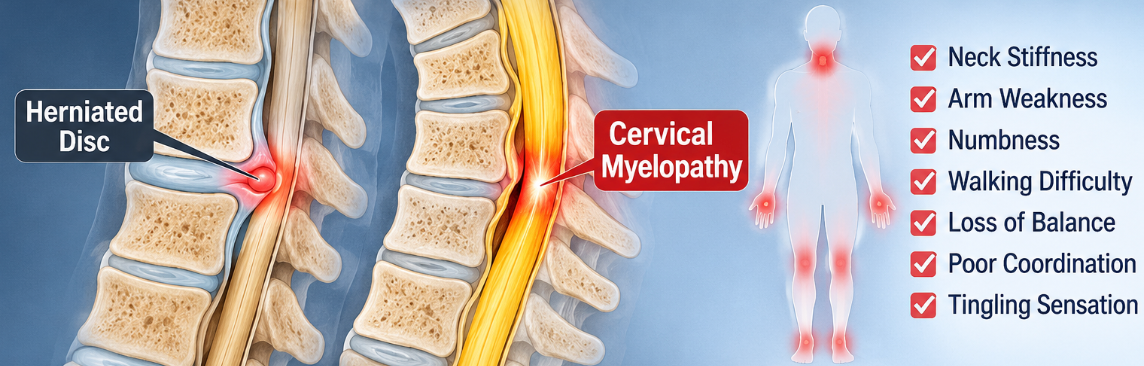
7 Warning Signs of Cervical Myelopathy
1. Tingling or electric shock-like sensations
You may feel a sudden tingling sensation in your shoulders, arms, hands, or feet. Some people describe it as an electric shock traveling through their body, particularly when moving their neck.
2. Weakness in the hands or arms
You may notice that everyday activities become more difficult. Squeezing toothpaste from a tube, gripping objects, or performing tasks that require fine finger movements may become challenging.
3. Numbness or unusual sensations in the legs
Persistent tingling, numbness, or a strange floating sensation in the feet may indicate a neurological problem, particularly when accompanied by weakness or walking difficulties.
4. Difficulty walking normally
Your walking pattern may change without an obvious reason. You might feel unsteady, walk more slowly, or find it difficult to move confidently.
5. Loss of balance on stairs or narrow paths
Difficulty walking down stairs, moving quickly, or maintaining balance on narrow surfaces can be an important warning sign. Some people describe the sensation as feeling as though they are walking on air.
6. Progressive weakness in the legs
If your legs feel increasingly weak or you struggle to walk or run as you once did, the symptoms should not automatically be attributed to aging or a lack of exercise.
7. Increasing difficulty with coordination
Problems controlling finger movements, unusual reflex responses, and worsening coordination can occur when the spinal cord is affected.
These symptoms do not automatically mean you have cervical myelopathy. However, progressive weakness, changes in walking, and loss of coordination warrant prompt medical evaluation.
What Causes Cervical Myelopathy?
Several conditions can narrow the spinal canal and compress the spinal cord.
-
Cervical disc herniation: A displaced disc presses against the spinal cord.
-
Ossification of the posterior longitudinal ligament (OPLL): A ligament along the back of the vertebral bodies gradually becomes hardened or bone-like, reducing the space available for the spinal cord.
-
Ossification or thickening of the ligamentum flavum: Changes in a ligament at the back of the spinal canal can contribute to compression.
-
Cervical spinal stenosis: Age-related or degenerative changes narrow the spinal canal and place pressure on the spinal cord.
In some cases, several of these conditions occur together, making the compression more severe.
How Is Cervical Myelopathy Diagnosed?
A medical evaluation typically includes a neurological examination to assess muscle strength, reflexes, sensation, coordination, and walking ability.
An MRI scan can help identify spinal cord compression and changes within the spinal cord itself. Depending on the suspected cause, additional imaging may be necessary to assess bone changes or ligament ossification.
Early diagnosis is important because symptoms can progress even when neck pain is relatively mild.

Does Cervical Myelopathy Require Surgery?
Treatment depends on the severity of spinal cord compression, the progression of symptoms, and the findings from neurological examinations and imaging.
When spinal cord compression causes progressive neurological deficits, surgery to relieve the pressure may be necessary. In contrast, some cases of cervical disc herniation without spinal cord involvement can be managed with nonsurgical treatments under medical supervision.
For cervical myelopathy, pain medication, injections, or physical therapy cannot reliably eliminate significant mechanical compression of the spinal cord. Treatment should therefore focus on identifying the underlying cause and preventing further neurological deterioration.
Surgical procedures vary according to the location and extent of compression. Some operations remove the affected disc and bone spurs from the front of the neck, followed by stabilization of the affected vertebrae. Other procedures, such as laminoplasty, enlarge the spinal canal from the back to create more room for the spinal cord.
The appropriate procedure must be determined by a qualified spine specialist based on the individual patient’s condition.
Can Cervical Myelopathy Cause Permanent Paralysis?
Yes. Severe or untreated spinal cord compression can cause lasting neurological impairment, including weakness, walking difficulties, and paralysis.
Even after surgery successfully relieves the compression, existing spinal cord damage may not fully recover. Some symptoms may improve gradually, while others can persist.
This is why it is important not to ignore progressive weakness or changes in balance simply because the neck does not hurt very much.
When Should You See a Doctor?
Seek prompt medical assessment if you experience worsening hand weakness, difficulty walking, repeated loss of balance, or increasing numbness and weakness in your limbs.
If weakness develops suddenly, you become unable to walk, or you experience rapidly worsening neurological symptoms, seek emergency medical care.
Remember: Neck pain is not the only warning sign of a serious cervical spine condition. Changes in your walking pattern, hand coordination, and muscle strength may be even more important. Early diagnosis and appropriate treatment can help reduce the risk of permanent spinal cord damage.
This information is for educational purposes and does not replace an examination by a qualified medical professional.
KOREA MEDI HUB. COMをもっと見る
購読すると最新の投稿がメールで送信されます。