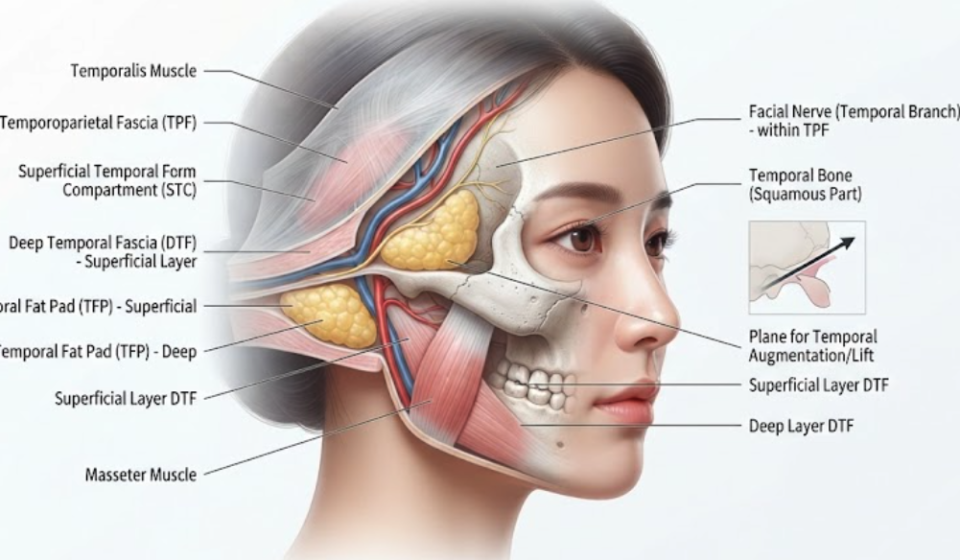
Temple Hollowing After Zygoma Reduction: The Hidden Side Effect Surgeons Rarely Discuss

Why cheekbone reduction can cause temporal hollowing — and how Korean surgeons fix it with modern techniques.
In Korea’s world‑leading facial contouring industry, zygomatic reduction surgery has become one of the most popular procedures for creating a slimmer, more refined facial shape. By reducing the width of the cheekbones, the face appears softer, more elegant, and more balanced.
But as the global demand for cheekbone reduction grows, a subtle yet increasingly recognized side effect has begun to attract attention: temple hollowing — a sunken appearance in the temporal region, located between the eyes and the hairline.
This phenomenon is not widely discussed in mainstream plastic surgery content. Yet among top Korean surgeons, temple hollowing is a well‑known aesthetic concern that can occur after zygoma reduction, especially in patients with certain anatomical characteristics.
This feature explores why temple hollowing happens, who is most at risk, and how Korean clinics correct or prevent it using advanced techniques such as fat grafting, temporal fascia release, and midface volume restoration.
⭐ What Is Temple Hollowing?
Temple hollowing refers to a sunken or concave appearance in the temporal region — the area on the side of the forehead, above the zygomatic arch. When this area loses volume or structural support, the face can appear:
- Older
- More skeletal
- Less vibrant
- Less balanced
- More angular than intended
In aesthetic terms, the temple is crucial for maintaining a youthful, smooth contour from the forehead to the cheekbone. When hollowing occurs, the face can lose harmony even if the cheekbone reduction itself was successful.
⭐ Why Temple Hollowing Happens After Zygoma Reduction
Although zygoma reduction focuses on the cheekbone, its effects ripple outward across the entire midface and temporal region. The relationship is anatomical, structural, and volumetric.
Here are the five major reasons temple hollowing can occur after cheekbone reduction:
⭐ 1) Loss of Lateral Support After Bone Movement
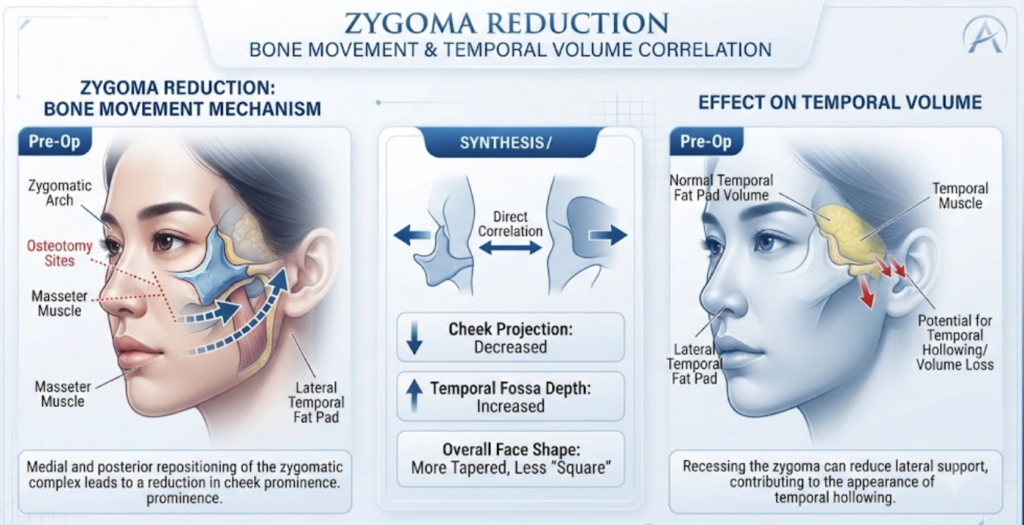
The zygomatic bone forms part of the lateral facial frame. When the cheekbone is moved inward:
- The lateral facial width decreases
- The soft tissue loses its underlying support
- The temporal region can appear more hollow
This is especially noticeable in patients with naturally thin soft tissue or low body fat.
⭐ 2) Soft Tissue Redundancy and Redistribution
After the cheekbone is reduced, the soft tissue that once stretched over a wider bone structure may become slightly loose. This can cause:
- Downward migration of temporal fat
- Redistribution of soft tissue volume
- Increased visibility of the temporal concavity
This is similar to how cheek sagging can occur after aggressive bone contouring.
⭐ 3) Changes in the Zygomatic Arch Tension
The zygomatic arch connects the cheekbone to the temporal bone. When the cheekbone is repositioned:
- The arch tension changes
- The temporal fascia may shift
- The overlying fat pad may lose structural support
This can create a subtle hollowing effect that becomes more visible over time.
⭐ 4) Natural Aging Accelerated by Bone Reduction
Bone reduction can make certain aging signs more noticeable, including:
- Temporal fat loss
- Fascia thinning
- Volume depletion
Patients over 35 are more likely to experience temple hollowing after zygoma reduction because the temporal region naturally loses volume with age.

⭐ 5) Pre‑existing Temple Concavity Becomes More Visible
Many patients already have mild temple hollowing before surgery.
Zygoma reduction can make this more noticeable by:
- Slimming the midface
- Reducing lateral projection
- Highlighting existing concavity
In these cases, the surgery does not cause hollowing — it simply reveals what was already present.
⭐ Who Is Most at Risk?
Temple hollowing is more common in:
- Patients with naturally thin faces
- Patients with low body fat
- Patients over 35
- Patients with pre‑existing temple concavity
- Patients who undergo aggressive zygoma reduction
- Patients with strong midface deflation tendencies
Korean surgeons often evaluate the temporal region during consultation to predict whether hollowing may occur.
⭐ How Korean Surgeons Fix Temple Hollowing
Korea is known for its advanced facial contouring techniques, and temple hollowing is no exception. Surgeons use several methods to restore volume and balance.
⭐ 1) Fat Grafting (Autologous Fat Transfer)
The most common and natural solution.
Fat is harvested from:
- Thigh
- Abdomen
- Flank
Then refined and injected into the temple.
Benefits:
- Natural look
- Soft texture
- Long‑lasting
- Minimal downtime
Korean clinics often use micro‑fat grafting for smoother results.
⭐ 2) Nano‑Fat + Micro‑Fat Combination
Nano‑fat improves skin quality.
Micro‑fat restores volume.
This combination:
- Smooths the temple contour
- Improves skin elasticity
- Creates a youthful transition from forehead to cheekbone
⭐ 3) Temporal Fascia Release
In some patients, the temporal fascia is tight, causing the hollowing to appear deeper.
Surgeons can:
- Release the fascia
- Create space for fat grafting
- Improve contour smoothness
This technique is used in advanced Korean clinics.
⭐ 4) Dermal Fillers (Temporary Option)
Hyaluronic acid fillers can temporarily correct temple hollowing.
Pros:
- Quick
- No downtime
- Adjustable
Cons:
- Not permanent
- May require maintenance
⭐ 5) Midface Volume Restoration
Sometimes temple hollowing is linked to midface deflation after zygoma reduction.
Solutions include:
- Midface fat grafting
- Deep plane facelift
- SMAS repositioning
- Malar fat pad elevation
This restores harmony between the temple and cheekbone.
⭐ Can Temple Hollowing Be Prevented?
Yes — Korean surgeons often prevent temple hollowing by:
- Avoiding excessive zygoma reduction
- Evaluating pre‑existing concavity
- Planning soft‑tissue support
- Combining cheekbone reduction with fat grafting
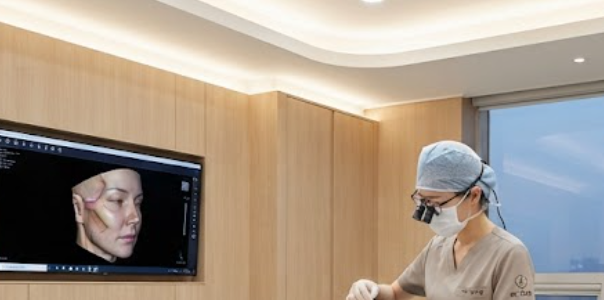
- Using 3D facial analysis
Prevention is especially important for patients with thin faces.
⭐ Why This Side Effect Is Rarely Discussed
Most clinics focus on:
- Slimmer face
- Smaller cheekbones
- V‑line results
But temple hollowing is a subtle, high‑level aesthetic issue that only becomes noticeable in certain patients.
It requires:
- Deep anatomical knowledge
- Experience with bone contouring
- Understanding of soft‑tissue behavior
This is why only top Korean surgeons discuss it openly.
⭐ Temple Hollowing Is Fixable — and Often Preventable
Temple hollowing after zygoma reduction is not a surgical failure.
It is a predictable anatomical response that can be corrected with modern techniques.
Korean clinics excel at:
- Volume restoration
- Soft‑tissue repositioning
- Natural contour smoothing
For patients seeking cheekbone reduction, understanding this side effect — and how to fix it — ensures better long‑term results and a more harmonious facial shape.
🔗 Official Clinic Resources (Kidari Plastic Surgery)
For readers seeking expert insight into facial contouring, temple hollowing correction, and zygoma reduction techniques:
✔ Kidari Plastic Surgery Clinic — Official Website
https://beanpoleps.com/intro.php
✔ More Korean Plastic Surgery Knowledge (Global Community)